What Is GOTS Organic Cotton — and Why It Matters for Your Packaging
On this page
GOTS is the Global Organic Textile Standard — a certification covering the whole supply chain, not just the cotton field. That distinction is the entire value of it. "Organic cotton" on its own describes how a crop was grown. GOTS additionally covers processing, chemical inputs, wastewater and labour conditions, and requires each link in the chain to be certified.

What GOTS actually covers
- Fibre content. A minimum proportion of certified organic fibre, verified rather than asserted.
- Processing chemistry. Restrictions on dyes, bleaches and auxiliaries — including the azo dyes that can release regulated aromatic amines.
- Wastewater. Requirements on treatment before discharge, which is where most textile processing does its environmental damage.
- Labour. Social criteria based on ILO conventions, covering working conditions through the chain.
- Chain of custody. Each processor holds its own certification, so the claim survives from field to finished bag.
That last point is what makes it meaningful. A certificate covering only the cotton farm says nothing about what happened in the dye house.
Why "organic" alone means very little
Unqualified terms — organic, eco-friendly, sustainable, natural — are not standardised in textiles and mostly cannot be verified. Cotton can be grown organically and then processed with restricted chemicals, dyed in a facility discharging untreated wastewater, and still be described as "organic cotton" in marketing.
If a supplier claims organic, ask which standard and for the certificate. If the answer is vague, treat the claim as marketing rather than fact.
What AZO-free means
Azo dyes are a large family of synthetic colourants. Most are unproblematic, but a subset can break down to release aromatic amines classified as carcinogenic, and those are restricted in textiles intended for skin contact under regulations including the EU's REACH.
"AZO-free" in practice means free of that restricted subset. It matters most on dyed and coloured bags, and matters more again where the bag holds food or is handled by children. It is a separate assurance from organic — a bag can be organic and dyed with restricted chemistry, or conventional and AZO-free.
Why it matters commercially
- Wholesale listings. Retailers increasingly require documented certification rather than a claim, and cannot list without it.
- Your own marketing. If you make an environmental claim on your packaging, you need to be able to evidence it — this is exactly the area regulators have been tightening.
- Food and children's products. Restricted-chemistry assurance is often a hard requirement, not a preference.
- Tenders and procurement. Corporate and public buyers usually ask for the certificate, not the adjective.
What to ask a supplier for
- Which standard, named explicitly — GOTS, OEKO-TEX, or another.
- The certificate itself, with its scope and validity dates. Certificates expire.
- Whether it covers the finished bag or only the raw fibre — these are very different claims.
- What the dyes are, if the bags are coloured, and whether AZO-free is documented.
A supplier who cannot produce documentation on request is telling you something useful. This is also the fourth item on the specification checklist in where to buy cotton drawstring bags in bulk.
Being honest about cotton's footprint
Worth stating plainly: cotton is water-intensive to grow, and a cotton bag has a higher production footprint than a single paper bag. Organic certification improves the growing and processing but does not eliminate that.
What changes the picture is lifespan. A bag reused dozens of times amortises its footprint across every use, while a single-use item carries its whole footprint in one outing. So the environmental case for cotton is conditional — it holds when the bag is genuinely kept and reused, and it does not hold if it is handed out once and discarded.
That is a practical argument for specifying a bag people want to keep rather than the cheapest available, and for restrained branding. A bag nobody carries has the worst footprint of all.
Our certification
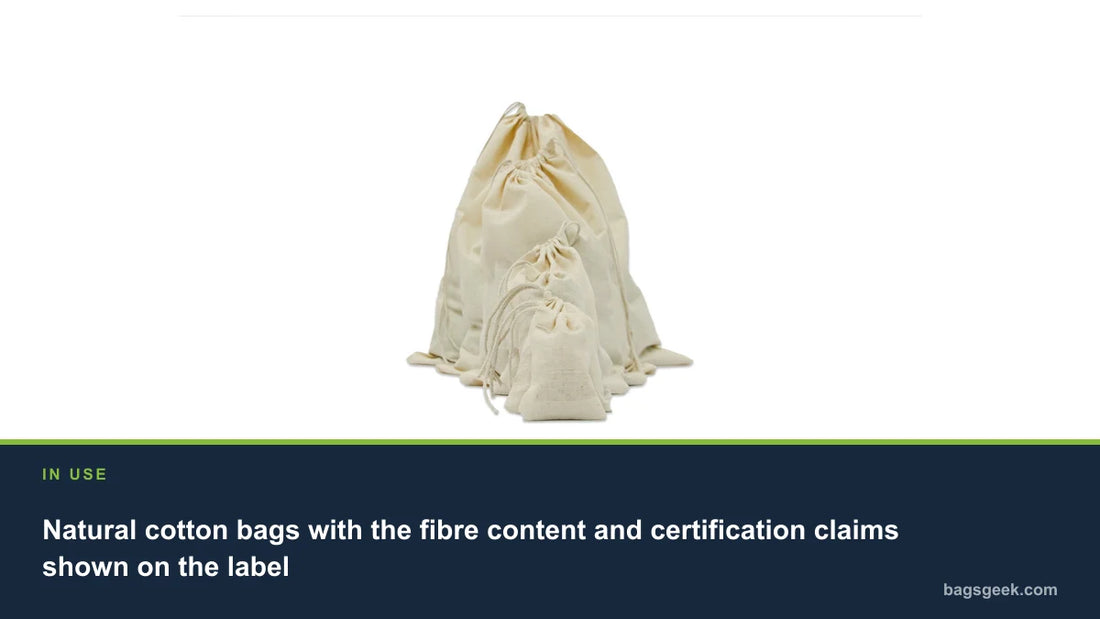
Our cotton is GOTS certified organic and AZO-free across the range — natural, white and dyed. If you need the certificate for a listing, a tender or your own claims, ask and we will send it.
Ordering
Browse the cotton drawstring bag range, muslin bags or cotton tote bags. For branded runs, custom drawstring bags with your logo. Related reading: white vs natural cotton and fabric vs paper and plastic.
Frequently asked questions
What does GOTS certified mean?
Global Organic Textile Standard — certification covering fibre content, processing chemistry, wastewater treatment and labour conditions across the whole supply chain, with each processor certified. It is a documented chain rather than a description of the fibre.
Is GOTS the same as organic cotton?
No. "Organic cotton" describes how the crop was grown. GOTS additionally covers what happens after the field — processing, dyes, wastewater and labour. Cotton can be organically grown and then processed in ways GOTS would not permit.
What does AZO-free mean?
Free of the subset of azo dyes that can break down to release aromatic amines classified as carcinogenic, which are restricted in textiles for skin contact. It is a separate assurance from organic and matters most on dyed bags and anything holding food.
Do I need certification for my own eco claims?
If you are making an environmental claim on packaging or in marketing, you should be able to evidence it. Ask your supplier which standard, for the certificate, and whether it covers the finished bag or only the raw fibre.
Are cotton bags actually better for the environment?
Conditionally. Cotton is water-intensive and has a higher production footprint than a single paper bag, but it amortises that across dozens of uses. The case holds when the bag is genuinely reused and fails if it is discarded after one outing.
Need the certificate for a listing?
Our cotton is GOTS certified organic and AZO-free. Ask and we will send the documentation.
Request certificationShop the range